


The average American adult now reports 2.23 close friendships, down from 2.94 in 1990, and 12% report having none at all - up from 3% a generation ago, according to the Survey Center on American Life. Whatever your circumstances, "finding your circle" as an adult is a harder problem than it used to be, because almost nothing about adult life produces friendship automatically the way school once did.
Here's a step-by-step framework, built from research on how friendship actually forms - along with real examples of the structures that put that research into practice. One of them is Les Amis, a curated membership community for women that we'll come back to throughout this guide as a concrete case study of what "someone else handles the planning" actually looks like in practice.
The biggest obstacle to finding your circle usually isn't a lack of desire to connect — it's the ongoing coordination required to keep seeing the same people, which is exactly the piece that a demanding adult schedule leaves the least room for.
Sociologist Ray Oldenburg's concept of the "third place" - a recurring space beyond home and work where the same people gather informally and repeatedly - describes why some settings reliably produce friendship and others don't. A gym class, a recurring volunteer shift, a standing hobby group all function as third places because they supply the repetition automatically; a one-off event, however well-attended, doesn't.
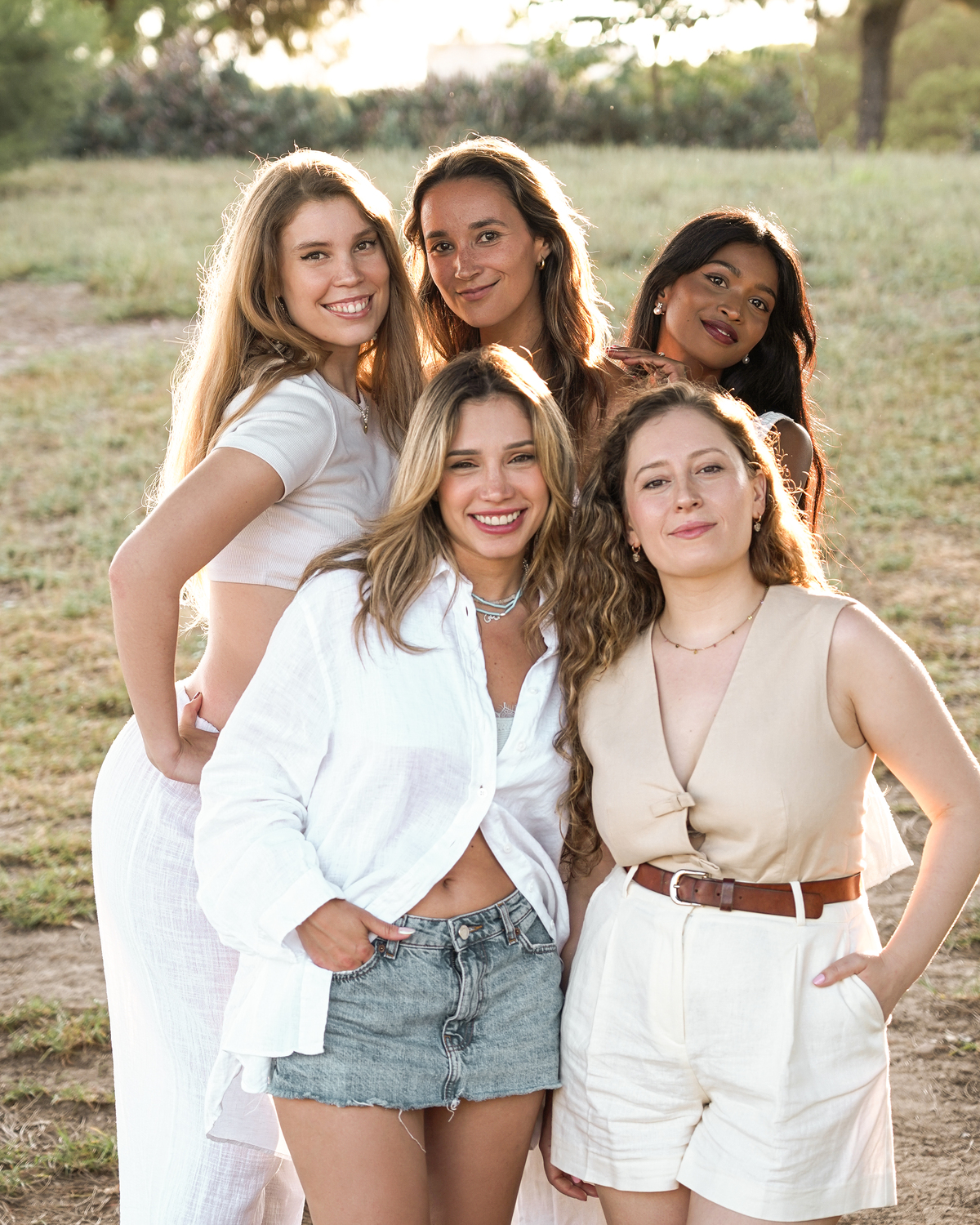
This is also the logic behind curated membership communities, which have grown as a category precisely because they build the third-place function directly into a product. Les Amis, mentioned above, is a clear example: an application-based women's community built entirely around recurring, structured contact rather than one-off events.
It's specifically for women, so it's one option among the structures below rather than a universal answer - but it's a useful, concrete case of the "someone else handles the planning" category this section describes. For everyone else, the same underlying logic - recurring, structured, planned-for-you contact - applies to professional associations, classes, sports leagues, and volunteer organizations with a fixed calendar.

Robin Dunbar's research describes friendship in layers: roughly 5 people in an innermost support group, 15 in a close-friend layer, 50 in a broader social network, and 150 as the outer limit of stable relationships. Most people who feel like they're "missing a circle" are really missing that innermost layer of 3 to 5 - an achievable number, not a large network.
Jeffrey Hall's research at the University of Kansas found it takes roughly 50 hours of shared time to become a casual friend and about 200 hours to become a close one. This reframes early interactions: a single good conversation that doesn't lead anywhere immediately isn't a failed attempt, it's hour two or three of a much longer process. Knowing the real number changes what "giving it a shot" should look like - repeated exposure, not a single high-effort event.
A classic 1950 study by Festinger, Back, and Schachter found that 65% of friendships in a university dormitory formed between residents living within five doors of each other - physical proximity, repeated automatically, outpredicted every measured personality variable. The practical translation: choosing the same recurring class, league, or group over several scattered one-off events is a stronger friendship strategy, even if any single instance of the recurring option feels less exciting than a novel event.
Research on the "acceptance prophecy", described by psychologist Marisa Franco and built on work by Danu Anthony Stinson, found that people who expect a warm reception behave more openly, and are, as a result, actually better received. Assuming rejection produces guardedness that reads as coldness; assuming acceptance produces the opposite. The instinct to hold back until you're sure of a good reception is, per this research, working against the outcome you want.
A 2012 study by Antheunis, Valkenburg, and Peter found that friendships which transition from an online or app-based connection into offline contact reach the same relational quality as friendships that started in person, while purely online or in-app connections plateau at a measurably lower level of closeness. Any promising connection made through an app, forum, or group chat is a starting point, not an endpoint; the research consistently favors moving it into shared physical space as early as is reasonable.
Once a connection looks promising, research on home-based interactions found that inviting people into your own space predicts growing closeness specifically, with a reciprocity pattern: people who are hosted tend to reciprocate, which builds the recurring contact from step 3 without requiring you to keep finding new venues.
Given the 200-hour figure from step 2, a circle built from a standing start realistically takes several months of consistent contact before it feels solid. The most common mistake is evaluating a promising new connection against a "close friend" standard after only a handful of interactions - a standard the research says isn't reachable that early regardless of how well the interactions go.
A: Set a realistic target using Dunbar's model (3 to 5 close relationships, not a large network), account for the real time investment using Hall's 50-to-200-hour framework, favour recurring structured activities over one-off events, and move promising connections into shared physical space as quickly as possible. Structures that build the recurring contact in for you solve the actual bottleneck, which is usually planning capacity rather than desire.
A: School and college supply automatic, repeated proximity with the same people every day - what sociologist Ray Oldenburg would call a built-in third place. Adult life rarely replaces that structure by default, so building a circle after those years generally requires deliberately choosing recurring activities rather than waiting for proximity to happen on its own.
A: Research doesn't point toward a large number. Robin Dunbar's model puts the innermost support layer at roughly 5 people, and most research on friendship quality favors a small number of consistent relationships over a wide network of acquaintances.
A: No, the mechanism that builds friendship (repeated, structured contact with the same people over time) works the same regardless of who arranges it. Apps and curated communities simply supply that structure directly, which removes the planning step that's usually the actual obstacle rather than a shortcut around real connection.
A: Based on Jeffrey Hall's research, roughly 200 hours with any one person to reach close-friend status - in practice, several months of consistent, recurring contact with a small group rather than weeks. Judging new connections too early is one of the most common reasons people give up before a genuine circle has had time to form.
Finding your circle isn't a matter of luck or timing, it has a researchable shape: a realistic target size, a real time cost, a strong preference for recurring structure over spontaneous one-off events, and a mindset of expecting a good reception rather than waiting to be sure of one. Whatever your specific circumstances, the underlying mechanism is the same one that's always built friendship: repeated contact with the same people, over enough time for it to compound.
We believe that a strong female circle is one of the key components of a successful and fulfilled life for every woman
Your family of girlfriends




.jpg)
.jpg)