%20(1).jpeg)
Most women underestimate how much their female circle - the small, close group of women friends someone can call without hesitation, not a wider social network - is doing for them. After a move, after a baby, after a breakup, after a chapter change at work, the absence of close women in your life tends to show up sideways: as fatigue, as a flatness you assume is temporary.
The evidence points the same direction across multiple studies. Women's friendships do something biologically, professionally, and emotionally that very few other relationships in our lives can replicate. They buffer stress at a hormonal level. They predict career outcomes more strongly than they predict men's. They extend lifespan. They are, according to the longest study of adult happiness ever conducted, the single biggest factor in whether a person ages well or poorly.
And yet, the 2026 reality is that women have fewer close friends than they did a decade ago. Pew Research's January 2025 report shows that while women are more likely than men to turn to friends for emotional support, the absolute number of close friendships has been shrinking, particularly for women in their 20s and 30s. The American Survey Center's State of American Friendship found that 59% of women aged 18–29 lost touch with at least a few close friends during the pandemic. The World Health Organization, in its June 2025 report on social connection, now classifies persistent loneliness as a public health crisis affecting one in six people worldwide.
.png)
This shrinking trend has a name: the Friendship Recession - a well-documented, multi-year drop in the number of close friendships adults report having, especially since 2020. And it's landed harder on women, who rely more heavily on close friendships for emotional support than men do.
That's not just a social inconvenience: the research below shows it touches your stress response, your career, your health, and how long you live. This article lays out five findings women should know about why a female circle matters, and what to do if yours has thinned out.
The fix isn't more free time - it's structure. Prioritise spaces built for repeated, in-person contact (a standing group, a recurring class, a curated community) rather than one-off meetups or chat-only apps.
Connection is part of how women's bodies process stress (for men, by the way, the mechanism works differently), and the absence of close female friends measurably weakens that buffer.
But until 2000, the dominant theory of how humans respond to stress was fight-or-flight: an evolutionary response built largely on male research subjects. In 2000, UCLA psychologist Shelley Taylor and her colleagues published a paper showing that women have a different default: a response her team called tend-and-befriend - nurturing the people around you and seeking out social connection, rather than fighting or fleeing. The mechanism is biological: oxytocin, modulated by oestrogen, is released in larger quantities under stress in women than in men, and it pushes the nervous system toward connection rather than confrontation or withdrawal.
The practical implication is this: when a woman doesn't have a strong female circle to "befriend" toward under stress, her built-in regulation system has nowhere to go. That's part of why the loneliness research consistently shows women feeling the absence of close friendships more acutely than men do - on a neurochemical, not just a social, level.
Women with a close inner circle of female friends are placed into leadership roles 2.5 levels higher than women with a male-dominated network. This effect doesn't exist for men.
In 2019, Yang Yang, Nitesh Chawla, and Brian Uzzi (Kellogg School of Management) published a landmark paper in PNAS titled A network's gender composition and communication pattern predict women's leadership success. The team analysed the social networks and post-graduate career placements of hundreds of MBA students, using 4.5 million email exchanges to map who actually talked to whom.
The findings were striking:
Why? The researchers' interpretation is that women need gender-related private information: informal data about which workplaces actually support women, which negotiation tactics work for whom, which hiring managers should be avoided; and that information moves through tight, trusted female-to-female networks. Men don't need this information to the same degree, so the composition of their network doesn't shape their trajectory in the same way.
The takeaway is plain: a close circle of women is a measurable input to her career.
The longest study of adult happiness ever conducted - 88 years and counting - has one consistent finding: relationship quality predicts health and life satisfaction more than cholesterol, money, IQ, or social class.
The Harvard Study of Adult Development, which began in 1938 and has followed thousands of participants for over eight decades, is the most thorough research effort on what actually makes a life good. Its current director, psychiatrist Robert Waldinger, has summarised the finding bluntly: at age 50, the people most satisfied in their relationships were the healthiest at age 80. Cholesterol levels at midlife predicted very little about how participants aged. The warmth and presence of their close relationships predicted nearly everything.
Waldinger and Marc Schulz extended this finding in their 2023 book The Good Life, where they describe what they call social fitness: the idea that, like physical fitness, relationship health requires regular tending. Friendships you don't maintain atrophy. And for women, given the tend-and-befriend wiring, the cost of atrophy weighs more heavily on the body and mind than it does for men
A landmark Nurses' Health Study analysis found that women with a larger number of close friends and family members at the time of a breast cancer diagnosis had significantly better survival outcomes - independent of disease stage.
The Nurses' Health Study is one of the longest-running epidemiological studies of women's health. In a 2005 analysis published in the Journal of Clinical Oncology, Candyce Kroenke and colleagues followed 2,835 women diagnosed with breast cancer and found that those who were socially isolated at the time of diagnosis had a substantially elevated mortality risk - even after adjusting for the stage of disease.
The mechanism the authors proposed goes like this: the women with close friendships received tangible caregiving, emotional support, and information about treatment that the more isolated women didn't. Multiple subsequent studies have replicated the finding in different cancer populations.
Women in long-term partnerships report higher overall wellbeing when they also have a strong female circle - because what close women friendships provide is structurally different from what a partner provides.
A common assumption among women in long-term relationships is that the partner becomes the primary social support, and the female circle is optional. The research disagrees. Studies of social support consistently show that women who rely solely on a partner for emotional support have higher rates of depression and lower life satisfaction than women who have both - even when the partnership itself is reported as happy.
The reason is partly about overload (one person cannot meet all of another person's relational needs) and partly about specificity. Friendships allow the type of disclosure and reciprocity that the partner relationship - with its sexual, financial, and domestic entanglements - cannot fully accommodate. Female friendships, in particular, are characterised by what researchers since the 1970s have called high-disclosure intimacy: an exchange of vulnerability that's harder to find in same-sex male friendships.
This is why the women who are most settled in their lives - partnered, professionally established, financially secure - often discover, in their 30s and 40s, that what's missing is exactly this: a small, consistent group of women they're known by.
The five findings above describe what a female circle does for a woman. The harder fact in 2026 is that, according to the American Survey Center, 59% of women aged 18–29 lost touch with at least a few close friends during the pandemic - a contraction researchers now call the Friendship Recession.
The Friendship Recession isn't a 2020 problem that's behind us. It's the residue of a five-year period in which women lost the structural opportunities to make and maintain close friendships: university communities scattered, workplaces went remote, neighbourhoods felt less neighbourly, and the friendships that survived did it because someone carried them.
If your female circle today is smaller than you'd like it to be, you are part of a generational pattern, not an individual failure.
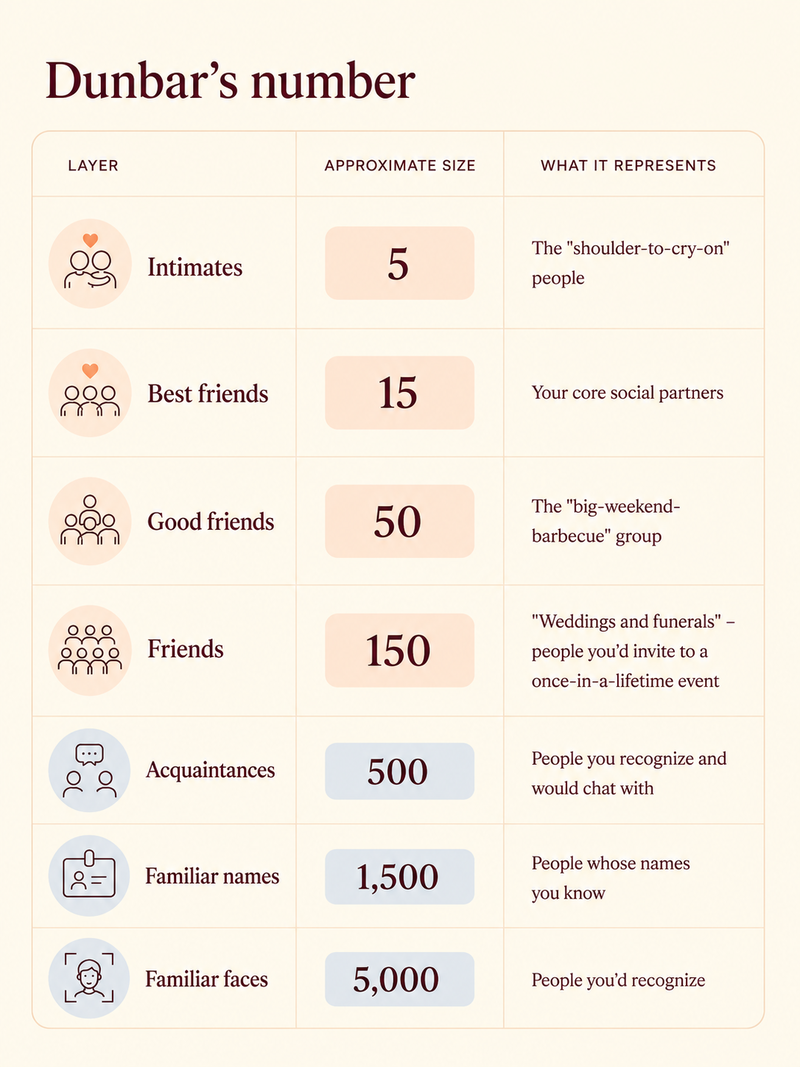
Anthropologist Robin Dunbar's research on social networks suggests humans operate with a series of nested friendship layers: roughly five intimate friends, fifteen close friends, fifty good friends, and an outer ring of about 150 stable acquaintances. The innermost layer, the five, is where most of the wellbeing benefits described above land.
A strong female circle, in practice, doesn't have to be large. The Yang/Uzzi PNAS study found the leadership-predictive pattern in groups of two to three women. The Harvard Study of Adult Development shows that the quality of relationships matters more than the quantity. A small, recurring, mutually disclosing group of women - meeting often enough, over enough years - is sufficient.
What it usually looks like:
If you read that list and recognise a gap, the next question is what to do about it.
Building a female circle as an adult is not the same as making friends in school. The structural occasions have evaporated, and most women will have to be more intentional about it than they would have been at 19. Three principles from the research:
1. Repeated contact is the mechanism. University of Kansas researcher Jeffrey Hall found in a 2018 study published in the Journal of Social and Personal Relationships that it takes roughly 50 hours for an acquaintance to become a casual friend, 90 for a friend, and 200 hours for a close friend. Friendships are built by hours, not by chemistry.
2. Assume people like you more than you think. Some social psychologists call it the acceptance prophecy: people who expect to be liked are warmer, which makes them more liked, which compounds. The single most reliable predictor of who makes friends as an adult is whether they walk into rooms expecting to be welcomed.
3. Prioritise spaces designed for in-person, recurring contact. This is where the chat-only apps fall short. The 200 hours require physical, repeated proximity. Apps and platforms that put you in real rooms with the same women repeatedly are the highest-signal route - whether that's a Lean In circle, a hobby league, a women's network like PWN, or a curated members club like Les Amis.
Les Amis was built for exactly this. Small-group dinners, workshops, and members trips across 12 cities - with committed women showing up to be in the room, week after week. If you want a female circle and the structural occasion to build one, you can apply to join here.
The research is consistent across stress biology, career outcomes, longevity, and life satisfaction: women metabolise stress through connection (the tend-and-befriend response - nurturing others and seeking social support, rather than fighting or fleeing - identified by Shelley Taylor in 2000), are placed in higher leadership roles when they have a strong female inner circle (Yang, Chawla & Uzzi, PNAS 2019), live longer when they have close friends (Nurses' Health Study), and report higher wellbeing in midlife and beyond when their relationships are strong (Harvard Study of Adult Development).
Women's nervous systems are wired to seek out social connection under stress. Without a close female circle, that built-in regulatory mechanism has nowhere to go, and stress tends to manifest as fatigue, low mood, and a higher risk of depression. Pew Research's 2025 data shows women are more likely than men to turn to friends specifically for emotional support, which means the absence of a circle hits women's mental health harder than it hits men's.
Three findings stand out. First, Shelley Taylor's tend-and-befriend research shows women respond to stress biologically through connection. Second, Yang, Chawla and Uzzi's 2019 PNAS study shows women with a close female inner circle are placed into leadership roles 2.5 levels higher than women without one. Third, the Harvard Study of Adult Development (88 years and counting) finds that the quality of relationships is the single biggest predictor of long-term health and happiness.
Anthropologist Robin Dunbar's research suggests the inner layer of human friendship is around five intimate friends, with a close-friend circle of about fifteen. But the wellbeing and career-outcome studies suggest the minimum is smaller: the Yang/Uzzi research found the leadership-predictive pattern in groups of two to three women. Quality matters more than quantity.
Female friendships are characterised by what researchers call high-disclosure intimacy - a pattern of mutual vulnerability and emotional reciprocity that men's friendships, on average, are less likely to show. Pew Research's 2025 data confirms women are significantly more likely than men to turn to a friend for emotional support, and decades of social psychology research show women's same-sex friendships tend to involve more talking, more sharing, and more emotional depth than men's same-sex friendships.
The research-backed approach is three things: prioritise spaces with repeated in-person contact; walk into rooms expecting to be welcomed; and choose structures that create recurring proximity to the same women - Lean In circles, women's professional networks, hobby leagues, or curated communities like Les Amis.
It's common, but the research suggests it has a cost. Women who rely mainly on male friends for emotional support tend to get less of it than they would from female friends - research on cross-sex versus same-sex friendship consistently finds that cross-sex friendships provide less help, loyalty, and intimacy than same-sex ones, and that women rate their friendships with other women as significantly higher in emotional support than their friendships with men.
A partner is one person. Even the best partner cannot fill the role of a female circle - partly because no single relationship can carry the full weight of a person's social needs, and partly because the type of disclosure women's friendships allow (about other women, about gender-specific experiences, about parts of life a partner is themselves entangled in) is different from what's possible in a romantic relationship. Women in healthy long-term partnerships report higher wellbeing when they also have a strong female circle.
If you read these five findings and recognise that something in your life is thinner than it should be, you're in the company of most women in 2026. The Friendship Recession is real. The structural occasions have shrunk. The research converges on the same conclusion about what your nervous system, your career, your health, and your life expectancy require.
The fix should be structural: choose spaces that put you in the same rooms with the same women, often enough, over enough time. The 200 hours will do their work. The acceptance you assume will draw the warmth back. And the circle that emerges from that - small, consistent, mutual - is the one the science says you actually need.
If you want a place built around exactly this kind of women's circle, Les Amis is here. Members-only, curated, in-person, in 12 cities across Europe and the US - and built for women who already know they need their people, and just need the room.
We believe that a strong female circle is one of the key components of a successful and fulfilled life for every woman
Your family of girlfriends